

Key takeaways
- Compare five aquarium gravel vacuums for clean tanks, with strong siphons, easy-start pumps, gravel guards and sizes for small and large tanks.
Gravel hides more waste than the glass ever shows. Uneaten food, plant debris, and fish waste settle between the stones, where they decay out of sight and slowly foul the water. A gravel vacuum lifts that waste out during a routine water change, pulling debris away with the flowing water while clean gravel drops back to the tank floor. The right tool turns a dreaded chore into a short routine.
The five vacuums below cover the main ways keepers clean a tank. There is a classic hand siphon for simple weekly changes, a bulb-primed siphon for small tanks, an electric cleaner for deep cleans, a push-button siphon with a filter basket, and a flow-controlled manual vacuum for precise work. Each one comes from a real listing with a confirmed code, so you can match the tool to your tank with confidence.
Quick Picks
As an Amazon Associate we earn from qualifying purchases
| Product | Best for | Key spec from title |
|---|---|---|
| Aqueon Siphon Vacuum Gravel Cleaner Medium 9-Inch | Simple weekly water changes | 9-inch tube, up-and-down priming |
| AQUANEAT Aquarium Vacuum Siphon Hand Pump | Small tanks and delicate fish | Hand pump bulb, 1.5-inch inlet |
| AQQA 6-in-1 Electric Gravel Cleaner VES701 | Deep cleans on large tanks | 20W motor, 320 GPH flow |
| SEAOURA Siphon Pump Gravel Cleaner SR-528 | Quiet manual cleaning with a filter basket | Air push button, 3-in-1 kit |
| AQQA Manual Gravel Vacuum AQ193 | Flow-controlled cleaning in shallow tanks | Flow regulator, tanks under 17 inches deep |
How to Choose
Match the tube to your tank depth
A short tube cannot reach the gravel in a tall tank, and a long tube is awkward in a shallow one. Measure from the rim to the substrate before you buy, then pick a tube that reaches the bottom with a little length to spare. Extension tubes help when one tank is deep and another is shallow, since you can add or remove sections to fit each setup. Electric models list a suitable tank height range, so check that range against your tallest tank. A tube that barely reaches the bottom forces you to tilt the tank or the tube, which stirs up debris instead of removing it.
Manual or electric
Manual siphons cost little, make no noise, and never need a plug, which suits small tanks and quiet rooms. They rely on gravity, so the bucket must sit below the tank, and your arm does the priming. Electric cleaners move water fast and handle deep gravel with less effort, which suits large or heavily stocked tanks. They need a power outlet, they hum while they run, and the pump must stay under water at all times. Pick manual when the tank is small and the routine is short; pick electric when the tank is large and the gravel is deep.
Mind the gravel and the fish
Wide tubes pull waste fast from coarse gravel but can swallow small pebbles and disturb delicate plants. Narrow tubes suit fine gravel and planted tanks, where gentle suction matters more than speed. A filter basket or strainer at the intake keeps fry, shrimp, and small fish out of the hose, which matters most in breeding tanks and nano setups. Sand needs a light touch: hover the tube above the surface and let it lift waste without pulling sand along. If your tank holds bottom dwellers that bury themselves, choose a model with a guard and work slowly around their hiding spots.
Hose length and bucket placement
A short hose ties you to a bucket parked right beside the tank, which is fine for a desktop setup and a nuisance beside a tall stand. Measure the distance from the tank rim to the floor, then add room for the bucket to sit clear of the stand. Gravity siphons need the outlet well below the inlet, so a long hose earns its keep on tall tanks. Electric models push water through the hose, so placement matters less, but the cord still needs to reach an outlet safely. Check the hose for kinks before each session, since a folded hose chokes flow and breaks the siphon.
The 5 Best Options
Aqueon Siphon Vacuum Gravel Cleaner Medium 9-Inch
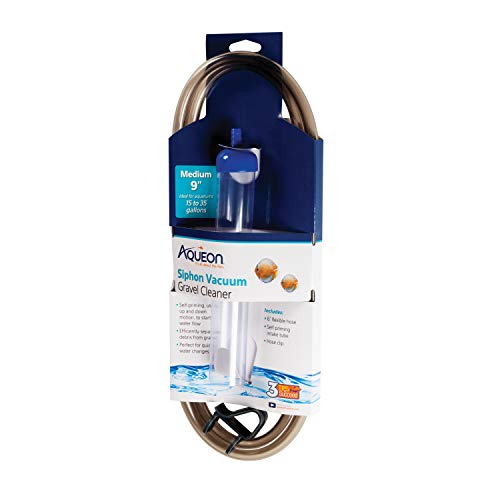
The Aqueon siphon is the classic tool most keepers learn on, and its simple design is the reason it lasts. A few up-and-down motions of the tube prime the flow, then gravity carries waste out while gravel tumbles back to the floor. The medium 9-inch tube suits standard community tanks, reaching the substrate without dwarfing a small setup. With no bulb, motor, or battery to fail, there is almost nothing to maintain beyond a rinse after each session. It is the honest baseline every other vacuum in this guide is measured against.
Specs
- Brand Aqueon; model 100106229
- Medium size with a 9-inch intake tube
- Item weight 9.6 ounces
- Up-and-down tube motion primes the siphon
- Manufacturer Central Garden and Pet
- Date first available August 18, 2004
- 90-day warranty
Best for: Keepers who want a simple, no-parts siphon for routine weekly changes.
Watch out for: The plain tube has no bulb, so priming takes a few up-and-down motions, and fine sand can clog the intake.
ASIN: B004RK1WBK
AQUANEAT Aquarium Vacuum Siphon Hand Pump

The AQUANEAT siphon trades the shake-to-prime motion for a hand pump bulb, which makes it friendlier for keepers who dislike the classic technique. Squeeze the bulb a few times and water begins to move, no mouth contact needed at any point. A filter screen at the intake guards small fish, so bettas, guppies, and fry stay in the tank while waste leaves it. The light build and short hose suit nano and desktop tanks, where a full-size siphon would be clumsy. It is the gentlest tool here, built for small water and small inhabitants.
Specs
- Brand AQUANEAT; hand pump bulb
- Squeeze the bulb 5 to 7 times to begin flow
- Filter screen keeps fish out of the hose
- Large configuration: 1.5-inch inlet, 1.6 m hose
- Small configuration: 0.25-inch inlet, 1.7 m hose, suits 5-gallon tanks
- Item weight 4.9 ounces
- Date first available July 10, 2020
Best for: Small tanks and keepers with bettas, guppies, or fry.
Watch out for: The short hose suits tanks near a bucket, and suction is gentle, so deep gravel beds take more passes.
ASIN: B08CRSHB8J
AQQA 6-in-1 Electric Gravel Cleaner VES701
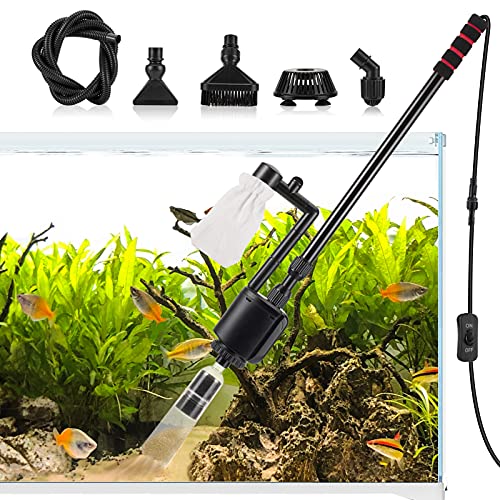
The AQQA VES701 is the powered workhorse of this group, built for keepers who clean large tanks and want the job done fast. Its 20W pump moves up to 320 gallons per hour, and the six functions cover water changes, sand washing, debris removal, filtration, showering, and circulation in one kit. Two extension tubes stretch the reach from about 17 to 34 inches, so tall tanks are no obstacle. A newer 36W version exists, so confirm the listing matches the VES701 20W model. For big or heavily stocked tanks, this is the fastest way through a deep clean.
Specs
- Brand AQQA; model VES701
- 6-in-1 functions: water changer, sand washer, debris cleaning, water filtration, water shower, water circulation
- Power 20W; voltage 110V/60Hz; flow 320 GPH
- Outlet 15 mm; power cord 5.6 ft
- Tube extends from 16.9 to 33.6 inches
- Suitable tank height 13.7 to 47.2 inches
- Suggested tank size 1 to 200 gallons
- Item weight 2.44 pounds; package 17.52 x 7.83 x 3.69 inches
- Date first available September 17, 2020
- Pump must stay fully submerged during use; water temperature 40 to 95 F
Best for: Large or heavily stocked tanks that need fast, powered cleaning.
Watch out for: A newer 36W version exists, so confirm the listing matches the VES701 20W model before ordering; the pump must stay submerged while running.
ASIN: B08JC4N2RG
SEAOURA Siphon Pump Gravel Cleaner SR-528

The SEAOURA SR-528 replaces the squeeze bulb with an air push button, a small change that makes priming quieter and more predictable. Press the button a few times and the siphon holds its flow without fuss, while a filter basket keeps gravel and small fish out of the hose. The kit handles gravel washing, scraping, and debris removal, so one tool covers most routine jobs. Gravity does the work, so the bucket must sit well below the tank, and the manual design means no cords, no batteries, and no hum. It is a calm, capable middle ground between a bare tube and a powered cleaner.
Specs
- Brand SEAOURA; model SR-528
- Air push button primes the siphon
- Gravity siphon: water outlet must sit at least 19 inches lower than the water inlet
- Filter basket keeps gravel and small fish out of the hose
- Item weight 1.08 pounds
- Item dimensions 7.16 x 1.77 x 16.41 inches
- Color silver gray and navy blue
- Date first available September 4, 2024
Best for: Keepers who want quiet manual cleaning without cords or batteries.
Watch out for: Gravity does the work, so the bucket must sit at least 19 inches below the tank inlet, and the push button needs firm presses to hold flow.
ASIN: B0DG2J1DBC
AQQA Manual Gravel Vacuum AQ193

The AQQA AQ193 is the newest tool here, a manual vacuum built around a flow regulator that lets you tune suction to the job. Open the regulator wide for coarse gravel, then dial it back for sand and delicate plants. Two extension tubes and a 2-meter hose give it reach beyond its compact size, and the filter basket net guards fry and shrimp during cleaning. The S size fits tanks under 17 inches deep, which covers most desktop and standard setups. It is the most controlled manual vacuum in this guide, and the best pick when precision matters more than raw flow.
Specs
- Brand AQQA; model AQ193
- Size S, for tanks under 17 inches deep
- Water flow regulator adjusts flow
- Filter basket net
- Includes 2 m (6.56 ft) hose, hose clamp, siphon ball, 2 extension tubes
- Item weight 11.6 ounces; package 10.43 x 4.53 x 2.4 inches
- Color black
- 1-year manufacturer warranty
- Must be completely immersed in water for use
- Date first available March 4, 2026
Best for: Shallow tanks under 17 inches deep where flow control matters.
Watch out for: The S size fits shallow tanks only, so measure tank depth first; the siphon ball must stay fully immersed during use.
ASIN: B0GFLPKHWC
Which One Fits Your Situation
A first tank under 20 gallons
Pick the AQUANEAT hand pump siphon. Its gentle suction and filter screen suit small water and small fish, and the bulb priming is easy to learn on a first tank. Pair it with a small bucket and a weekly routine, and the gravel stays clean without disturbing the cycle. Skip the electric cleaner until the tank grows.
A large community tank with deep gravel
Pick the AQQA VES701 electric cleaner. Its powered flow reaches deep substrate fast, and the extension tubes cover tall tanks without tilting. The six functions mean one kit handles water changes and sand washing together. Keep the pump submerged and the cord clear of the water, and a big clean takes minutes instead of an afternoon.
A betta or fry tank with tiny fish
Pick the AQUANEAT or the AQQA AQ193 with its regulator turned low. Both guard small inhabitants with a filter screen or basket, and both let you work slowly around fry and shrimp. Vacuum in short sections and watch the intake, lifting the tube whenever a curious fish drifts close. Gentle suction beats fast suction when the tank holds lives smaller than a coin.
A keeper who hates cords and plugs
Pick the Aqueon siphon or the SEAOURA push-button model. Both run on gravity alone, make no noise, and store in a drawer between sessions. The Aqueon suits keepers who like the classic technique, while the SEAOURA suits those who prefer a button to a shake. Either way, the only power involved is your arm and a bucket on the floor.
Common Mistakes
- Vacuuming the entire gravel bed in one session, which strips the bacteria that keep the water safe — clean a third of the bed each week instead.
- Setting the bucket level with the tank, which kills gravity flow — the outlet must sit well below the inlet for a siphon to hold.
- Switching on an electric cleaner with the pump above the water line, which can burn out the motor — submerge it fully first.
- Plunging a wide tube into fine sand, which pulls the substrate up the hose — hover above sand and let the flow lift waste only.
- Skipping the hose check before each session, so a kink or a clogged screen turns a quick clean into a flooded floor.
Frequently Asked Questions
How often should I vacuum aquarium gravel?
Most tanks need a gravel vacuum once a week, during the regular water change. Lightly stocked tanks can stretch to every two weeks, while heavily stocked tanks may need two short sessions a week. Clean about a third of the bed each time so the helpful bacteria in the gravel stay intact.
Do I need to remove my fish before vacuuming gravel?
No. Fish can stay in the tank while you vacuum, and moving them causes more stress than the cleaning itself. Work slowly, keep the intake away from resting fish, and use a filter screen or basket when the tank holds fry or shrimp. If a fish seems panicked, pause and let it settle before you continue.
Can a gravel vacuum work on sand?
Yes, with a light touch. Hold the tube just above the sand so the flow lifts waste without pulling grains along, and turn the flow down if your model has a regulator. Wide-bore tubes and strong electric suction can strip sand from the bed, so use the narrowest intake that still clears debris.
Why does my siphon lose suction halfway through?
The most common cause is air entering the hose through a loose connection or a kink that breaks the flow. Check that every joint is tight, the hose has no folds, and the outlet stays below the tank water line. A clogged screen can also choke flow, so rinse the intake guard and try again.
More from Amazon
Programs that pair well with the guide above. Offers and eligibility are set by Amazon and may change.
Free shipping on eligible items, Prime Video and more. Eligible new members can start with a free trial.
Start a Prime free trialAudiobooks and podcasts to listen to on the go. Eligible new members can start with a free trial.
Try Audible freeAd-free music streaming. Eligible new subscribers can start with a free trial.
Try Music Unlimited freeA free business account with business pricing and bulk-buying tools for work, shop or home office.
Create a business accountAs an Amazon Associate we earn from qualifying purchases.






Write Your Review
No reviews yet. Be the first to share your experience!