

Key takeaways
- Five multimeters for car battery checks and home electrical work, from a pocket Fluke to a true-RMS AstroAI, with specs on counts and current.
A multimeter earns its place in a garage when it answers a plain question fast: is this battery holding charge, is this fuse open, or is this wire live. Cars and houses share the same basic checks — voltage, continuity, resistance — but they stress a meter differently. A car battery test wants a solid DC current range and a battery mode that loads the cell. A household check wants clear AC voltage readings and a safety class that matches the panel. The five meters below cover both worlds.
As an Amazon Associate, we earn from qualifying purchases.
Quick Answer
For most car owners, the INNOVA 3320 is the pick: its load-based battery mode with color LEDs makes a 12-volt battery verdict obvious, and it still handles home voltage and continuity checks. For serious home work too, move to the Fluke 117 for true-RMS readings, non-contact voltage detection, and a 10-amp current range.
How to Choose a Multimeter for Cars and Home Use
Match the meter to the circuits you will touch. A car owner needs DC voltage to at least 20 volts, DC current to 10 amps for parasitic draw work, and a fast continuity beeper. A household user needs AC voltage to 600 volts, a CAT III 600-volt safety class, and a display that stays readable in a dim basement.
Counts tell you how fine the display can read: a 6,000-count meter shows values up to 5,999, enough to spot a 0.2-volt drop across a corroded terminal. True-RMS matters when the waveform is not a clean sine wave — inverter output, a variable-speed motor, or a dimmer circuit all read low on an averaging meter.
Safety class is the one spec to never trade away. CAT III 600 volts covers fixed installations such as distribution panels, while CAT II covers plug-in appliances only. A 10-amp range without a fuse can fail violently if the leads land across a live circuit, so check whether the 10-amp jack is fused first. For battery health, prefer a meter with a dedicated battery mode, which loads the cell and reports the result.
1. INNOVA 3320 Auto-Ranging Digital Multimeter
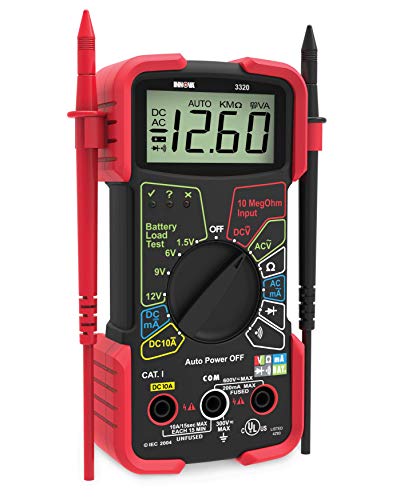
The INNOVA 3320 is the most car-focused meter here, thanks to its battery mode. Instead of showing a bare voltage number, it places a small load on the cell and lights a green, yellow, or red LED for 1.5-volt, 6-volt, 9-volt, and 12-volt batteries. The meter is auto-ranging, and the large display reads well at arm’s length under a hood.
The 10-amp DC range is unfused, so it belongs on car battery work only, never across household mains. There is no capacitance range.
Specs
- Display: auto-ranging, large LCD with backlight
- Voltage: DC 200 millivolts to 600 volts, AC 2 to 600 volts; DC accuracy 0.8 percent plus 5 digits
- DC current: 20 milliamps to 10 amps (10-amp range unfused)
- AC current: 20 to 200 milliamps
- Resistance: 200 ohms to 20 megohms
- Battery mode: load-based checks for 1.5, 6, 9, and 12 volts with LED indicators
- Safety class: 600 volts CAT II
- Power: two AA batteries, auto shut-off after 15 minutes
- Size and weight: 5.5 by 3.5 by 1.25 inches, 6.4 ounces
2. Fluke 117 Electrician’s True-RMS Multimeter

The Fluke 117 is the professional pick, built for commercial electrical work and equally at home on a car. Its standout feature is VoltAlert, a non-contact voltage detector in the meter body: hold the tip near a wire and it signals whether the conductor is live. AutoVolt picks AC or DC voltage automatically, and the LoZ mode stops ghost voltage — stray readings induced on dead wires — from sending you down the wrong path.
Min, Max, and Average recording catches intermittent faults, such as a voltage dip when a compressor kicks in. It carries a CAT III 600-volt safety class, a 3-year warranty, and a 9-volt battery that typically lasts about 400 hours without the backlight. At 550 grams, it is the heaviest meter here.
Specs
- Display: true-RMS, 6,000 counts, 33-segment bar graph, backlit
- Voltage: DC 600 millivolts to 600 volts, AC true-RMS to 600 volts; DC accuracy 0.5 percent plus 2 digits
- AC and DC current: to 10 amps, 20-amp overload for 30 seconds
- Resistance: to 40 megohms
- Capacitance: to 9,999 microfarads
- Frequency: to 50 kilohertz
- Special modes: VoltAlert, AutoVolt, LoZ, Min, Max, and Average recording
- Safety class: CAT III 600 volts
- Power: 9-volt alkaline battery, about 400 hours typical without backlight
- Size and weight: 6.57 by 3.31 by 1.82 inches, 550 grams
3. AstroAI DM6000AR True-RMS Digital Multimeter

The AstroAI DM6000AR packs the widest measurement set in this guide. It is a true-RMS, 6,000-count meter with auto and manual ranging, and its DC voltage ceiling of 1,000 volts beats the two Fluke models here. It also tests temperature with an included K-type thermocouple, from minus 40 to 1,370 degrees Celsius.
Practical touches include a backlit display, data hold, a hanging magnet, a kickstand, and a transistor test socket. It is safety classed CAT III 600 volts and CAT II 1,000 volts and runs on a single 9-volt battery. The extra ranges suit a hobbyist who repairs electronics as well as cars.
Specs
- Display: true-RMS, 6,000 counts, backlit, auto and manual ranging
- Voltage: DC 600 millivolts to 1,000 volts, AC 600 millivolts to 750 volts; DC accuracy 0.8 percent plus 3 digits
- DC and AC current: 600 microamps to 10 amps
- Resistance: 600 ohms to 60 megohms
- Capacitance: 60 nanofarads to 60 millifarads
- Frequency: 0 to 60 megahertz
- Temperature: minus 40 to 1,370 degrees Celsius with K-type thermocouple
- Extra functions: diode test, continuity, transistor hFE, data hold
- Safety class: CAT III 600 volts, CAT II 1,000 volts
- Power: one 9-volt battery
4. KAIWEETS HT118A True-RMS Digital Multimeter
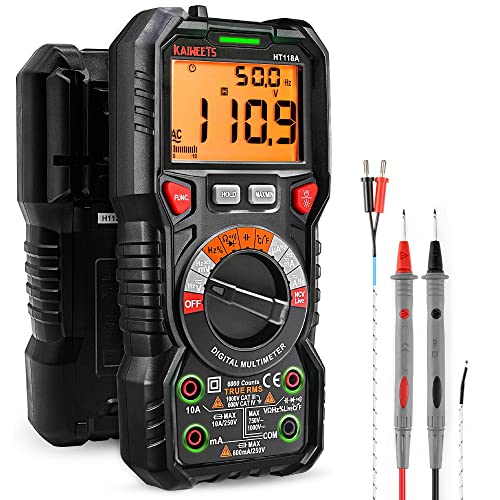
The KAIWEETS HT118A is the safety-minded value pick, and its live-wire features set it apart from the AstroAI. Non-contact voltage detection warns you before you touch a conductor, a Live function identifies a live wire among a bundle, and the LED jack indicator lights up when a lead sits in the wrong socket. A built-in flashlight helps in dark engine bays, and the meter is safety classed CAT III 600 volts.
It matches the AstroAI closely on range, adding capacitance, temperature, frequency, duty cycle, diode, and continuity to the same true-RMS base. It suits a car owner who also does household work and wants the meter to catch wiring mistakes. Its weakness is documentation: the fuse details are not clearly published, so treat the current ranges with care and never use them across mains circuits.
Specs
- Display: true-RMS, 6,000 counts, auto-ranging, backlit
- Voltage: DC to 1,000 volts, AC to 750 volts
- AC and DC current: to 10 amps
- Resistance: to 60 megohms
- Extra functions: capacitance, temperature, frequency, duty cycle, diode test, continuity, NCV, Live wire detection
- Safety features: LED jack indicator, flashlight, CAT III 600 volts
5. Fluke 101 Basic Digital Pocket Multimeter

The Fluke 101 is the smallest and simplest meter here and the lightest Fluke handheld made. It is auto-ranging, has a data-hold button, and shuts itself off to save the two AAA batteries. Its CAT III 600-volt safety class matches the Fluke 117.
What it does not do is measure current at all — there are no amp or milliamp ranges — and it has no backlight, so night work under a hood is harder. Those limits define its role: quick voltage, resistance, and continuity checks in a glovebox, not full diagnosis. Note that the US listing for the 101 is an Asia-market model, so confirm the seller and warranty coverage before buying.
Specs
- Display: auto-ranging, 6,000 counts, no backlight
- Voltage: DC 6 to 600 volts, AC 600 millivolts to 600 volts; DC accuracy 0.5 percent plus 3 digits
- Resistance: 400 ohms to 40 megohms
- Capacitance: to 1,000 microfarads
- Frequency: to 100 kilohertz
- Duty cycle: 1 to 99
- Extra functions: diode test, continuity buzzer, data hold
- Current ranges: none
- Safety class: CAT III 600 volts
- Power: two AAA batteries, auto power-off
- Size and weight: 5.1 by 2.6 by 1.1 inches, 5.6 ounces
Who Should Skip These Multimeters
Skip the Fluke 101 if you need to measure current — checking parasitic draw is impossible without an amp range. Skip the INNOVA 3320 if you work on household mains regularly: its CAT II class and unfused 10-amp range are wrong for panel work. Skip the Fluke 117 if your checks are basic — its VoltAlert and LoZ features are wasted on someone who only checks a car battery twice a year. Skip the AstroAI and KAIWEETS if you want a long, clearly documented warranty and fuse specifications. And skip all five if you need a code reader: no multimeter reads engine trouble codes, and an OBD2 scanner is the right tool for that job.
FAQ
Can a multimeter check whether a car battery is still good?
Yes, with a caveat. A plain voltage reading shows the resting charge, but a battery can read 12.6 volts and still fail under load. A meter with a battery mode, like the INNOVA 3320, loads the cell and gives a clearer verdict. Without one, measure voltage while a helper cranks the engine — a healthy battery holds above about 9.6 volts.
What does CAT III 600 volts mean on a multimeter?
It says the meter is built to survive transient voltage spikes in fixed installations, such as distribution panels and hardwired outlets. CAT III 600 volts covers most household work; CAT II covers plug-in appliances only and is not enough for panel work. Never use a meter above its stated safety class.
Do I need a true-RMS meter for home use?
It depends on your circuits. A standard averaging meter reads pure sine-wave mains voltage correctly, so basic outlet checks are fine. True-RMS matters when the waveform is distorted — dimmers, variable-speed motors, and inverter output all read low on an averaging meter. If your home has dimmers or your garage runs an inverter, a true-RMS meter is the safer choice.
Why does my multimeter show voltage on a wire that should be dead?
That is usually ghost voltage: a dead wire next to a live one picks up a small induced voltage, and a high-impedance meter shows it as if the wire were live. The Fluke 117 has a LoZ mode that loads the circuit slightly and clears ghost readings. On other meters, confirm with a non-contact voltage detector first.
Final Verdict
For a car owner who wants clear battery answers, the INNOVA 3320 is the most direct pick: its load-based battery mode turns a guess into a verdict, and it still covers the home checks most people need. If one meter must do everything, the Fluke 117 is the strongest choice, with true-RMS accuracy, non-contact voltage detection, and a current range the pocket Fluke lacks. The AstroAI DM6000AR and KAIWEETS HT118A cover nearly the same ground for less, with the KAIWEETS adding live-wire warnings beginners will appreciate. The Fluke 101 stays as the honest pocket option: small, accurate, and safe for voltage work, as long as you accept that it cannot measure current. Match the safety class to the circuit, confirm the listing and stock before buying, and never use the current ranges across household mains.
Product and ASIN Reference
| Product | ASIN |
|---|---|
| INNOVA 3320 Auto-Ranging Digital Multimeter | B000EVYGZA |
| Fluke 117 Electrician’s True-RMS Multimeter | B000O3LUEI |
| AstroAI DM6000AR True-RMS Digital Multimeter | B071JL6LLL |
| KAIWEETS HT118A True-RMS Digital Multimeter | B07SHLS639 |
| Fluke 101 Basic Digital Pocket Multimeter | B00HE6MIJY |
More from Amazon
Programs that pair well with the guide above. Offers and eligibility are set by Amazon and may change.
Free shipping on eligible items, Prime Video and more. Eligible new members can start with a free trial.
Start a Prime free trialAudiobooks and podcasts to listen to on the go. Eligible new members can start with a free trial.
Try Audible freeAd-free music streaming. Eligible new subscribers can start with a free trial.
Try Music Unlimited freeA free business account with business pricing and bulk-buying tools for work, shop or home office.
Create a business accountAs an Amazon Associate we earn from qualifying purchases.










Write Your Review
No reviews yet. Be the first to share your experience!